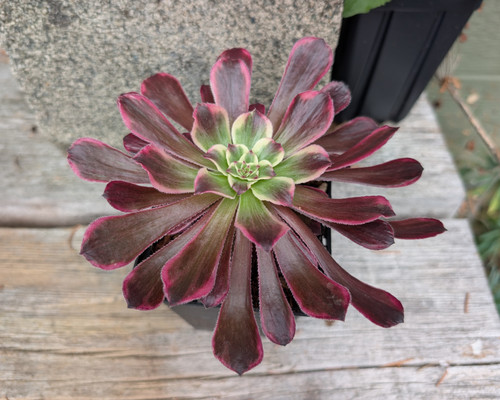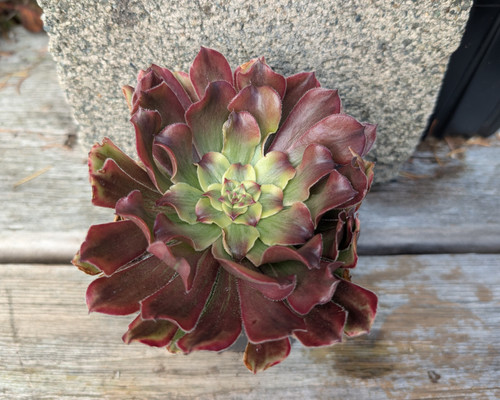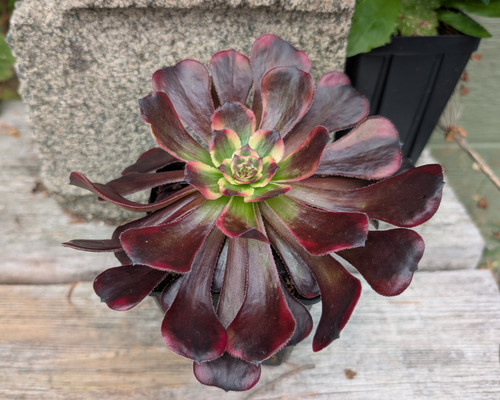


Pot Size: 3.5"
Accepted Scientific Name: Aeonium hybrid 'Mi Ji'
Origin and Habitat:
Aeonium 'Mi Ji' is a cultivated ornamental succulent hybrid belonging to the Crassulaceae family. Its ancestry is associated with Aeonium species native primarily to the Canary Islands, with additional species occurring in Madeira, North Africa, and parts of East Africa. These plants naturally inhabit rocky slopes, volcanic terrain, and exposed coastal environments characterized by mild temperatures and seasonal rainfall. Aeoniums are adapted to Mediterranean-type climates, typically growing actively during cooler months and entering partial dormancy during periods of intense summer heat. 'Mi Ji' is a horticultural selection valued for its distinctive foliage colours and ornamental rosette formation rather than a naturally occurring species.
Description:
Aeonium 'Mi Ji' is a striking ornamental succulent hybrid distinguished by its broad, elongated, spoon-shaped leaves arranged in an open, symmetrical rosette. The foliage displays rich burgundy to nearly black-purple colouring, highlighted by vivid crimson-red margins and contrasting pinkish-red tones toward the centre. Under bright light and cooler growing conditions, the leaves develop particularly intense pigmentation, creating a dramatic multicoloured appearance. Mature rosettes may reach approximately 6–10" across, with plants developing short, branching, woody stems and potentially reaching 12–24" tall under favourable conditions. Established plants may eventually produce upright flower stalks bearing clusters of small, star-shaped flowers, although flowering characteristics for this particular hybrid are not well documented. Its bold foliage and architectural growth habit make it an excellent specimen for succulent collections, decorative containers, and frost-free gardens.
Cultivation:
Zone: 9–11; protect from frost and prolonged freezing temperatures.
Temperature: Optimal growth at 12–25 °C. Protect from temperatures below 5 °C and prolonged exposure above 30 °C.
Growth Rate: Moderate during cooler months, with reduced growth or partial dormancy during hot summer conditions.
Soil: A well-draining succulent mixture containing pumice, coarse mineral aggregates, and a moderate amount of organic matter. Excellent drainage is essential to prevent root rot.
Watering: Water thoroughly during active growth, allowing the upper portion of the growing medium to dry between waterings. Reduce watering during hot summer dormancy and avoid prolonged saturation.
Fertilizing: Apply a balanced, diluted fertilizer every 2–3 weeks during active growth. Discontinue feeding during summer dormancy.
Light: Bright light to partial sun. Gentle morning sunlight encourages compact growth and stronger burgundy-red foliage colouring. Protect from intense afternoon sunlight during hot weather.
Pests and Diseases: Susceptible to mealybugs, aphids, scale insects, and root rot caused by excessive moisture. Poor air circulation and prolonged wet conditions may encourage fungal diseases.
Propagation:
Easily propagated through stem cuttings. Select healthy, mature rosettes with approximately 3–5" of attached stem and allow the cut surfaces to dry and callus for several days. Insert cuttings into a well-draining growing medium containing pumice and a small amount of organic matter. Maintain temperatures around 18–24 °C in bright, indirect light. Water sparingly until roots develop, generally within several weeks. Propagation is most successful during the cooler active growing season. Vegetative propagation preserves the distinctive foliage colours and growth characteristics of the cultivar.