

Pot Size: 3.5" pot
Accepted Scientific Name: Echinocactus platyacanthus Link & Otto
Synonym: Echinocactus ingens
Origin and Habitat
Echinocactus platyacanthus, commonly known in cultivation as Echinocactus ingens, is native to central and northern Mexico. It occurs in arid and semi-arid regions, particularly on rocky limestone slopes, desert scrub, and open grasslands at moderate elevations. Plants grow in mineral-rich, highly porous soils where rainfall is seasonal and drainage is rapid. This species is adapted to intense sunlight, prolonged dry periods, and considerable fluctuations between daytime and nighttime temperatures.
Description
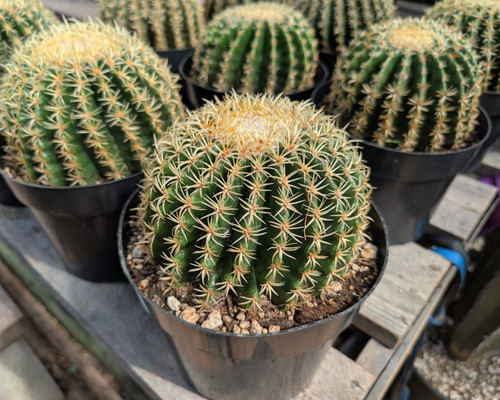
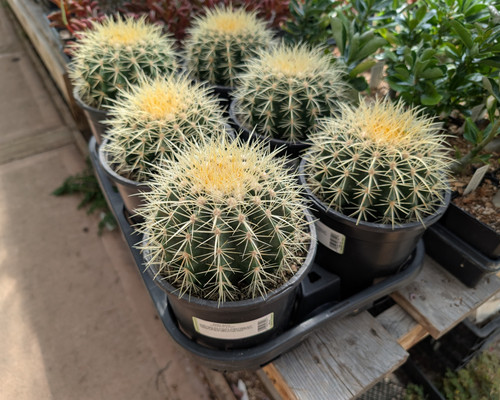
Echinocactus ingens is an impressive barrel cactus that develops a massive solitary stem with age. Young plants are globular to broadly cylindrical with pronounced ribs and large, woolly areoles bearing strong, slightly curved spines. As shown in our plants, juvenile specimens have attractive blue-green to grey-green bodies contrasted by reddish-brown to dark brown spines. Mature specimens can eventually exceed 60" tall and 30" wide in habitat, although growth is considerably slower in containers. Older plants produce small yellow flowers around the woolly crown.
Cultivation
Zone: 9–11
Temperature: 8–30°C during active growth; established plants can tolerate brief cooler conditions when completely dry, but protect from frost.
Growth Rate: Slow, particularly when young; growth gradually increases under favourable conditions.
Soil: Very porous cactus soil with a high proportion of pumice or other mineral material.
Watering: Water thoroughly during active growth, allowing the soil to dry completely between waterings. Keep substantially drier during winter.
Fertilizing: Apply a diluted low-nitrogen cactus fertilizer approximately once a month during spring and summer.
Light: Bright light to full sun. Acclimate young or greenhouse-grown plants gradually to intense direct sunlight.
Pests and Diseases: Generally robust but may be affected by mealybugs, scale, spider mites, and root rot when kept excessively wet.
Propagation
Primarily propagated from seed. Germination is generally straightforward under warm conditions, although seedlings require several years to develop the characteristic heavy ribs and formidable spination of mature plants.