

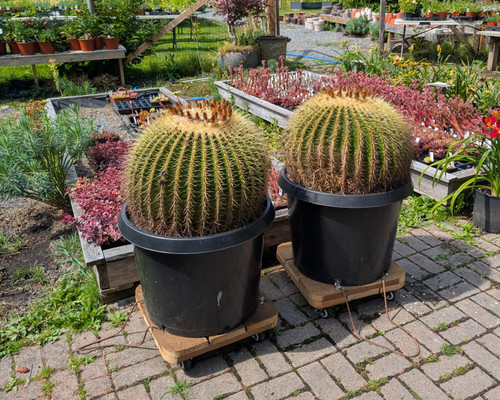
Pot Size: 20 Gal
Accepted Scientific Name: Echinocactus grusonii
Origin and Habitat
Echinocactus grusonii is native to central Mexico, primarily the states of Hidalgo and Querétaro, where it grows on rocky volcanic slopes and well-drained limestone hillsides. It thrives in hot, arid environments with intense sunlight, seasonal rainfall, and mineral-rich soils. Although once widespread, wild populations have declined dramatically due to habitat loss, making the species critically endangered in its natural range. Today, it is one of the most widely cultivated cacti in the world, admired for its striking symmetry, golden spines, and exceptional drought tolerance.
Description
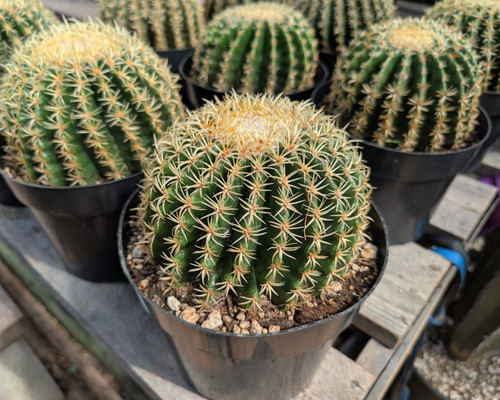
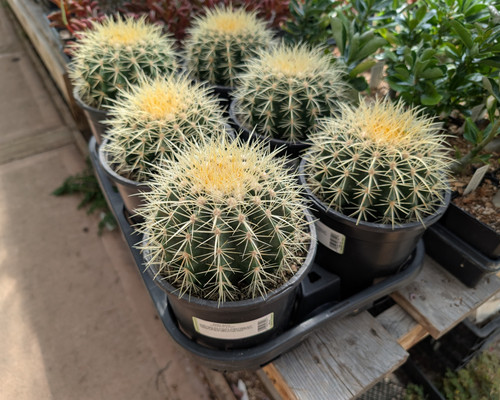
Echinocactus grusonii, commonly known as the Golden Barrel Cactus, is a slow-growing, solitary cactus that develops into a nearly spherical to slightly cylindrical stem reaching 24–48 inches (60–120 cm) tall and 18–36 inches (45–90 cm) wide with age. The vibrant green body is divided into numerous prominent ribs lined with dense clusters of brilliant golden-yellow spines that create its distinctive appearance. Mature specimens produce large, bright yellow flowers around the crown during summer, followed by woolly seed capsules. Its perfectly symmetrical form and bold architectural presence make it one of the most iconic cacti for containers, rock gardens, and desert landscapes.
Cultivation
Zone: 9–11
Temperature: 5°C to 38°C
Growth Rate: Slow.
Soil: Use a sharply drained cactus soil containing pumice, coarse mineral aggregate, and organic matter. Excellent drainage is essential to prevent root rot.
Watering: Water thoroughly only after the soil has completely dried during active growth. Keep nearly dry throughout winter dormancy.
Fertilizing: Feed every 3–4 weeks during spring and summer with a low-nitrogen cactus fertilizer diluted to half strength.
Light: Full sun to bright light. Gradually acclimate young plants to intense sunlight to avoid sunburn.
Pests and Diseases: Generally resistant to pests but may occasionally develop mealybugs, scale insects, or spider mites. Overwatering and poorly drained soil are the primary causes of root rot.
Propagation
Primarily propagated from seed, as mature plants rarely produce offsets.