

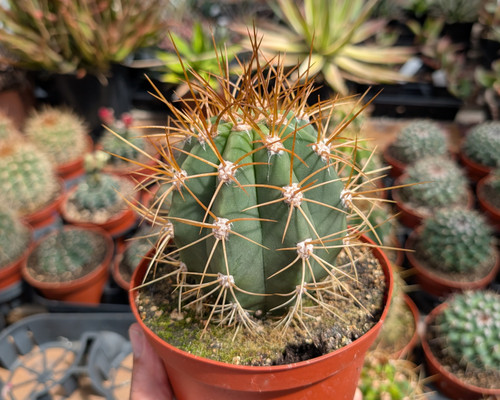
Pot Size: 6"
Accepted Scientific Name: Trichocereus terscheckii (syn. Echinopsis terscheckii)
Origin and Habitat:
Trichocereus terscheckii is native to the arid regions of northwestern Argentina, where it grows on rocky slopes, dry valleys, and desert plains at elevations ranging from 500 to 2,000 metres. These environments experience intense sunlight, seasonal rainfall, extended drought, and significant temperature fluctuations. As one of South America's largest columnar cacti, it has evolved a massive water-storage capacity and extensive root system that allow it to thrive under harsh desert conditions. Mature specimens often dominate the landscape and may live for well over a century.
Description:
Commonly known as the Argentine Saguaro, Trichocereus terscheckii is a majestic columnar cactus capable of reaching 20–40 feet tall in habitat. Young plants begin as stout solitary columns with blue-green to grey-green stems divided into prominent ribs. Large golden-yellow to amber spines emerge from woolly areoles, creating a striking contrast against the stem. As plants mature, they develop multiple branches near the upper portion of the trunk, producing a dramatic candelabra-like form. Mature specimens produce large fragrant white flowers up to 8 inches across that open primarily at night and attract pollinators. Its imposing architecture makes it one of the most spectacular columnar cacti in cultivation.
Cultivation
Zone: 8b–11
Temperature: -8 to 40°C
Growth Rate: Moderate
Soil: Extremely well-draining cactus soil containing pumice, gravel, and mineral aggregates
Watering: Water deeply during active growth, allowing soil to dry completely between watering; reduce watering significantly during winter
Fertilizing: Every 2–3 weeks during active growth using a diluted balanced fertilizer
Light: Full sun
Pests and Diseases: Generally pest resistant; excessive moisture may lead to root rot and stem damage
Propagation:
Primarily propagated from seed. Seedlings grow steadily and develop increasingly robust spination and columnar growth as they mature.


