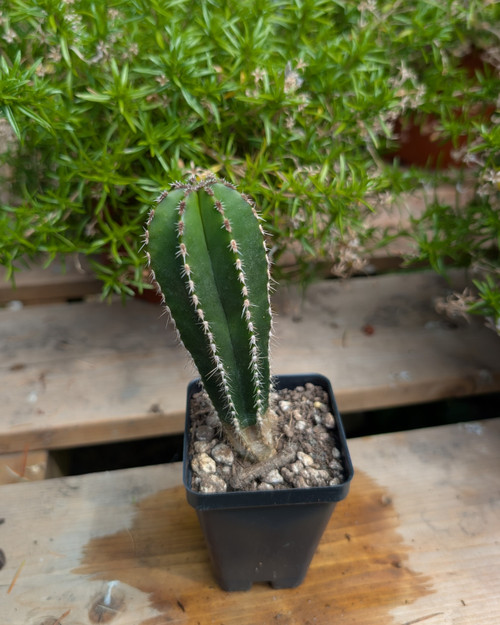


Pot Size: 10"
Accepted Scientific Name: Pachycereus pringlei
Origin and Habitat
Pachycereus pringlei is native to the Sonoran Desert of Baja California and northwestern Mexico, where it dominates rocky hillsides, alluvial plains, and desert valleys. It thrives in one of the hottest and driest environments in North America, growing in mineral-rich, well-drained soils under intense sunlight. Adapted to extreme drought, this remarkable cactus stores large quantities of water within its massive stems, allowing it to survive prolonged dry periods. As the world's tallest cactus species, it plays a vital ecological role by providing food and nesting sites for birds, bats, and other desert wildlife.
Description
Pachycereus pringlei, commonly known as the Cardón Giant, is the world's tallest cactus, eventually reaching heights of 40–60 feet (12–18 m) with massive trunks that can exceed 3 feet (1 m) in diameter. Young plants remain solitary for many years before developing impressive branching near the upper stem. The blue-green to grey-green stems have 11–17 prominent ribs lined with clusters of stout spines that become less pronounced with age. Mature plants produce large, creamy white flowers near the stem tips during spring, opening at night and remaining open into the morning to attract bats, moths, and bees. Although slow growing in cultivation, it becomes a magnificent specimen with exceptional longevity.
Cultivation
Zone: 9–11
Temperature: 5°C to 40°C
Growth Rate: Slow.
Soil: Use a sharply drained cactus soil containing pumice, coarse mineral aggregate, and organic matter. Excellent drainage is essential.
Watering: Water thoroughly when the soil has completely dried during active growth. Keep almost completely dry throughout winter.
Fertilizing: Feed every 3–4 weeks during spring and summer with a low-nitrogen cactus fertilizer diluted to half strength.
Light: Full sun. Provide abundant sunlight to encourage strong, compact growth and healthy spine development.
Pests and Diseases: Generally resistant to pests but may occasionally develop mealybugs, scale insects, or spider mites. Overwatering and poor drainage can cause root rot.
Propagation
Primarily propagated from seed. Large mature specimens may also be propagated from stem cuttings, which should be allowed to callus thoroughly before planting.