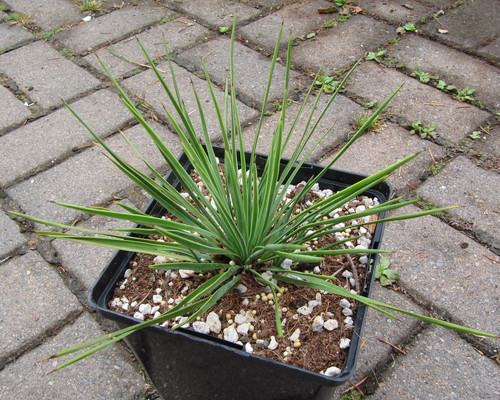

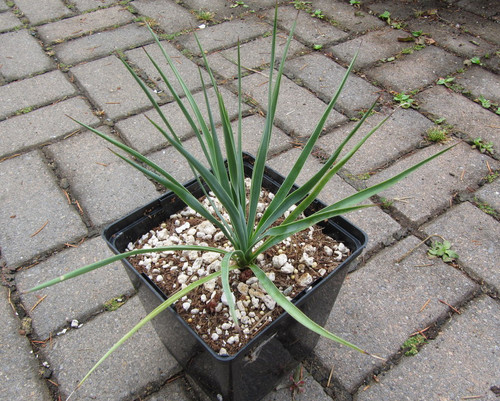
Pot Size: 3.5"
Accepted Scientific Name:
Yucca rostrata ‘Sapphire Skies’
Origin and Habitat:
Yucca rostrata is native to the arid regions of northern Mexico, particularly Coahuila and Chihuahua, extending into western Texas. It grows on rocky slopes and desert grasslands at elevations between 1,000 and 2,000 meters, where rainfall is minimal and temperature fluctuations are extreme. ‘Sapphire Skies’ is a selected cultivar valued for its intensified blue foliage color. Like the species, it is adapted to full sun, sharp drainage, and dry atmospheric conditions, making it well suited for xeriscapes and drought-tolerant plantings.
Description:
Yucca rostrata ‘Sapphire Skies’ is a sculptural, trunk-forming evergreen reaching 48–96 inches tall and 24–36 inches wide. It develops a solitary trunk topped with a dense, symmetrical rosette of narrow, sword-like leaves up to 24 inches long. The foliage displays a vivid sapphire-blue tone, more pronounced than the species, especially in full sun. Mature plants may produce a tall flower spike bearing clusters of creamy-white, bell-shaped flowers in summer. Its bold architectural form and intense coloration make it a striking focal point in containers and dry landscapes.
Cultivation:
Zone: Suitable for USDA zones 5 to 10.
Temperature: Tolerates temperatures from -20°C to over 40°C once established.
Growth Rate: Moderate, gradually forming a noticeable trunk over time.
Soil: Requires sharply draining soil amended heavily with pumice to ensure excellent aeration.
Watering: Water deeply but infrequently, allowing soil to dry completely between applications. Extremely drought-tolerant when established.
Fertilizing: Apply a diluted, balanced fertilizer every 2–3 weeks during the active growing season.
Light: Performs best in full sun; maximum light enhances blue coloration and compact growth.
Pests and Diseases: Generally resistant to pests; occasional scale may appear. Root rot can develop in poorly drained or overly wet soil.
Propagation:
Propagated primarily by seed. Offsets are rare but may be removed and replanted when present. Seeds require warmth and consistent moisture for germination.