

Pot Size: 3.5"
Accepted Scientific Name:
Yucca linearifolia
Origin and Habitat:
Yucca linearifolia is native to northeastern Mexico, particularly in the states of Coahuila and Nuevo León. It grows on limestone slopes and rocky desert hillsides in arid to semi-arid climates, often at moderate elevations. The region experiences intense sun exposure, low annual rainfall, and significant temperature fluctuations between seasons. This species has adapted to survive in sharply draining soils with minimal organic matter. Its natural environment favors drought tolerance, strong light exposure, and excellent air circulation, making it highly resilient in xeric landscapes and dry gardens.
Description:
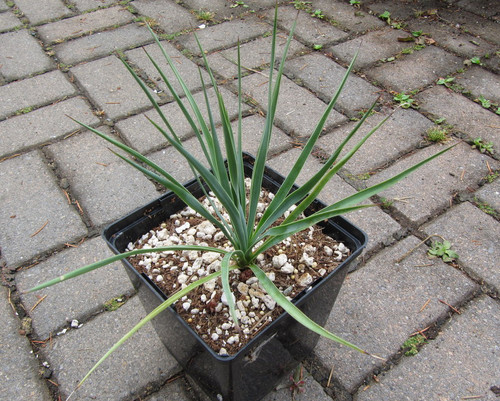
Yucca linearifolia is a refined, trunk-forming species reaching 60–96 inches tall and 24–36 inches wide. It develops a solitary trunk topped with a dense, rounded crown of very narrow, linear leaves up to 18–24 inches long. The foliage is soft blue-green to silvery-blue, thinner and more flexible than Y. rostrata, giving the plant a graceful, fountain-like appearance. Mature specimens may produce a tall inflorescence bearing clusters of creamy-white, bell-shaped flowers in late spring to early summer. Its symmetrical form and fine-textured leaves create a sophisticated architectural accent in modern desert plantings.
Cultivation:
Zone: Suitable for USDA zones 7 to 10.
Temperature: Performs best between 10°C and 35°C; tolerates brief drops to approximately -15°C when dry.
Growth Rate: Moderate, forming a trunk steadily over several years.
Soil: Requires sharply draining soil amended generously with pumice to ensure excellent drainage and root health.
Watering: Water deeply but infrequently, allowing soil to dry completely between waterings. Highly drought-tolerant once established.
Fertilizing: Apply a diluted, balanced fertilizer every 2–3 weeks during the active growing season.
Light: Thrives in full sun; strong light enhances leaf color and maintains compact growth.
Pests and Diseases: Generally pest-resistant; occasional scale insects may occur. Root rot is possible in poorly drained or consistently wet soils.
Propagation:
Propagated primarily from seed. Seeds require warm temperatures and consistent moisture to germinate. Offsets are uncommon but can be separated when present.