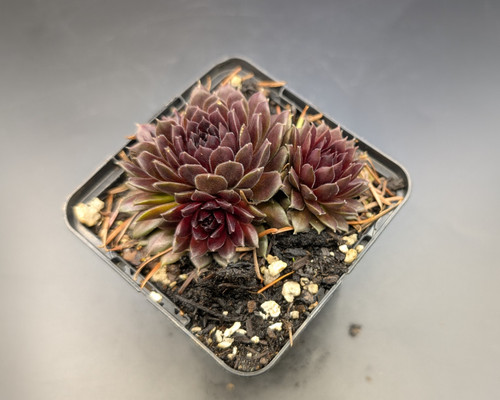

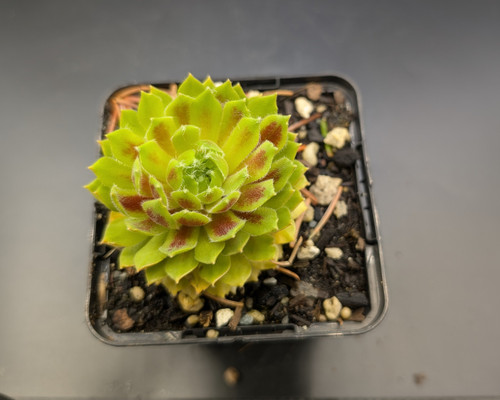
Pot Size: 3.5"
Accepted Scientific Name:
Sempervivum ‘Colorockz® Lemon Flare’
Origin and Habitat:
The genus Sempervivum is native to the mountainous regions of Europe, including the Alps and Carpathians, where plants grow in rocky crevices, alpine slopes, and well-drained, mineral soils. These environments are defined by intense sunlight, cold winters, and limited water availability. ‘Colorockz® Lemon Flare’ is a cultivated selection bred for its vibrant coloration and compact rosette form. Like its alpine ancestors, it is highly resilient to cold, drought, and wind, making it ideal for rock gardens, containers, and exposed landscapes.
Description:
Sempervivum ‘Colorockz® Lemon Flare’ forms tight, symmetrical rosettes measuring 3–5 inches in diameter, spreading to 8–12 inches wide through offsets. The fleshy, pointed leaves display bright lemon-yellow to chartreuse tones with contrasting red to burgundy tips, intensifying in cooler temperatures and full sun. The rosettes cluster densely over time, creating a colorful mat. In summer, mature rosettes may produce a short flower stalk with star-shaped pink flowers, after which the flowering rosette dies and is replaced by surrounding offsets.
Cultivation:
Zone: Suitable for USDA zones 4 to 9.
Temperature: Tolerates temperatures from -30°C to 30°C.
Growth Rate: Moderate, spreading steadily by offsets.
Soil: Requires sharply draining soil; amend with pumice to ensure excellent aeration and prevent excess moisture.
Watering: Water sparingly, allowing soil to dry completely between waterings. Very drought-tolerant once established.
Fertilizing: Apply a diluted, balanced fertilizer every 2–3 weeks during the growing season, though minimal feeding is required.
Light: Thrives in full sun; strong light enhances yellow coloration and red highlights.
Pests and Diseases: Generally pest-free; susceptible to rot in poorly drained or consistently wet soils.
Propagation:
Easily propagated by separating offsets (chicks) from the mother plant. Replant in well-draining, pumice-rich soil and water lightly until established.